
Thank you for Subscribing to Food Business Review Weekly Brief


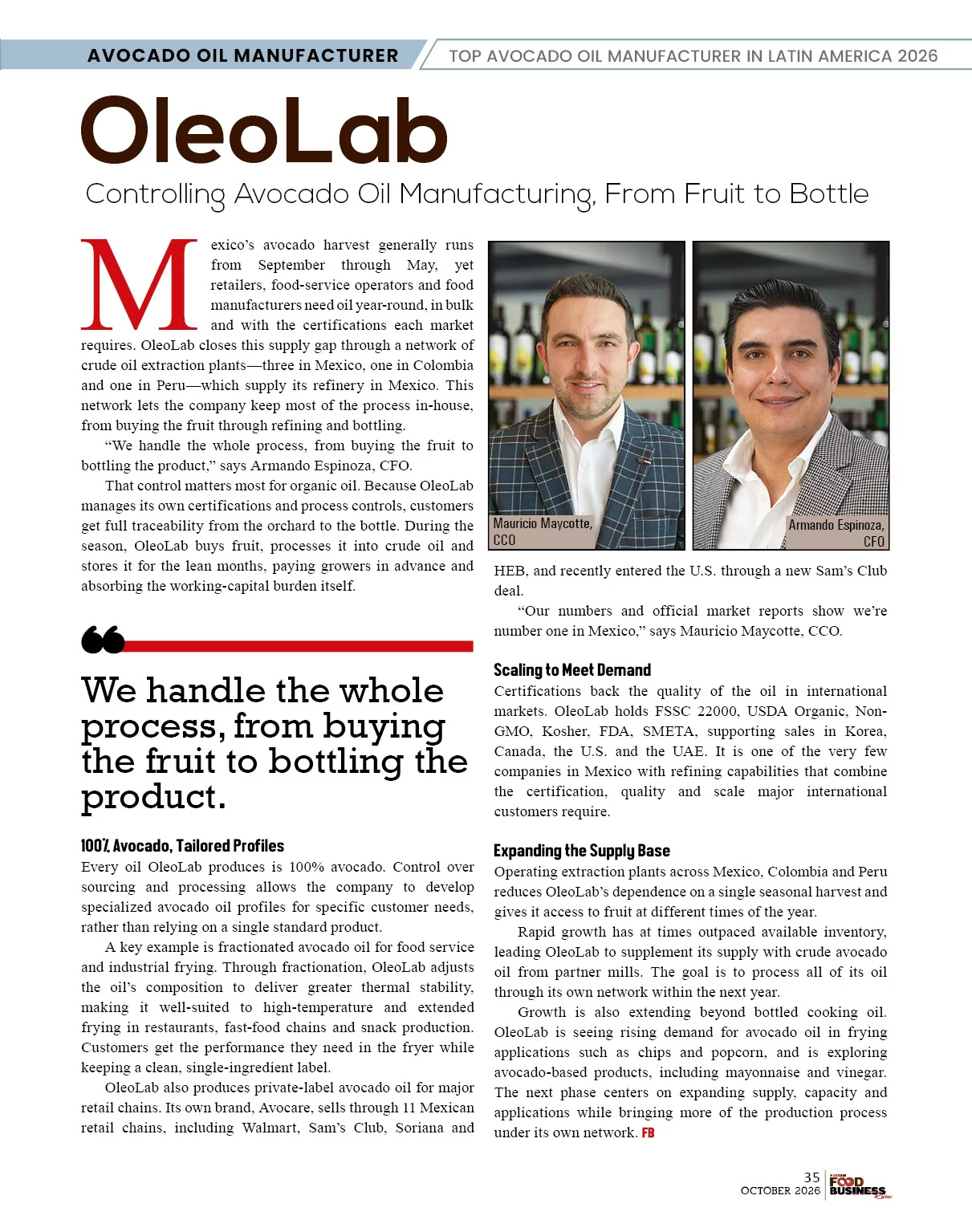
 Mauricio Maycotte, CCO and Armando Espinoza, CFO
Mexico’s avocado harvest generally runs from September through May, yet retailers, food-service operators and food manufacturers need oil year-round, in bulk and with the certifications each market requires. OleoLab closes this supply gap through a network of crude oil extraction plants—three in Mexico, one in Colombia and one in Peru—which supply its refinery in Mexico. This network lets the company keep most of the process in-house, from buying the fruit through refining and bottling.
“We handle the whole process, from buying the fruit to bottling the product,” says Armando Espinoza, CFO.
That control matters most for organic oil. Because OleoLab manages its own certifications and process controls, customers get full traceability from the orchard to the bottle. During the season, OleoLab buys fruit, processes it into crude oil and stores it for the lean months, paying growers in advance and absorbing the working-capital burden itself.
100% Avocado, Tailored Profiles
Every oil OleoLab produces is 100% avocado. Control over sourcing and processing allows the company to develop specialized avocado oil profiles for specific customer needs, rather than relying on a single standard product.
A key example is fractionated avocado oil for food service and industrial frying. Through fractionation, OleoLab adjusts the oil’s composition to deliver greater thermal stability, making it well-suited to high-temperature and extended frying in restaurants, fast-food chains and snack production. Customers get the performance they need in the fryer while keeping a clean, single-ingredient label.
-
We handle the whole process, from buying the fruit to bottling the product.
OleoLab also produces private-label avocado oil for major retail chains. Its own brand, Avocare, sells through 11 Mexican retail chains, including Walmart, Sam’s Club, Soriana and HEB, and recently entered the U.S. through a new Sam’s Club deal.
“Our numbers and official market reports show we’re number one in Mexico,” says Mauricio Maycotte, CCO.
Scaling to Meet Demand
Certifications back the quality of the oil in international markets. OleoLab holds FSSC 22000, USDA Organic, Non-GMO, Kosher, FDA, SMETA, supporting sales in Korea, Canada, the U.S. and the UAE. It is one of the very few companies in Mexico with refining capabilities that combine the certification, quality and scale major international customers require.
Expanding the Supply Base
Operating extraction plants across Mexico, Colombia and Peru reduces OleoLab’s dependence on a single seasonal harvest and gives it access to fruit at different times of the year.
Rapid growth has at times outpaced available inventory, leading OleoLab to supplement its supply with crude avocado oil from partner mills. The goal is to process all of its oil through its own network within the next year.
Growth is also extending beyond bottled cooking oil. OleoLab is seeing rising demand for avocado oil in frying applications such as chips and popcorn, and is exploring avocado-based products, including mayonnaise and vinegar. The next phase centers on expanding supply, capacity and applications while bringing more of the production process under its own network.
Securing Consistent Avocado Oil Supply
Avocado oil procurement becomes difficult long before a purchase order is issued. Fruit availability shifts across harvest windows, while refined-oil capacity is far more concentrated than raw-fruit supply. A manufacturer may quote attractive annual volumes yet still depend on outside crude oil when local fruit tightens. For buyers serving retail or food manufacturing, that gap appears later as shipment variability or forced reformulation. Supply planning should start with where fruit is sourced and how much of the conversion process the manufacturer controls.
Year-round continuity matters, but inventory strategy matters just as much. Avocado fruit is seasonal in major producing regions, so processors often build crude-oil inventories during harvest periods and carry working capital for months before finished product is sold. A credible supplier should explain how it bridges low-fruit months without diluting specifications or relying on opaque spot purchases. Buyers should also test whether announced capacity reflects only initial processing or extends through final bottling. Refining bottlenecks can be more decisive than nominal fruit throughput. Contract terms should also distinguish routine seasonal planning from emergency substitution because both affect price exposure and the buyer’s ability to forecast finished-goods availability.
Traceability becomes especially important in organic and private-label programs. A certificate at the refinery does not automatically establish what happened earlier in the chain if crude oil was acquired from another processor. Procurement teams need documentation that links fruit intake to finished oil and preserves product identity across handoffs. Batch-level visibility reduces ambiguity when a retailer or export customer asks for proof of origin. It also gives the buyer a stronger basis for investigating deviations without reconstructing the supply chain after the fact. Certification belongs in the same assessment. Food safety or organic credentials matter only when they match the destination market and cover the facility performing the relevant work.
“Oleolab controls fruit procurement and carries the oil through refining to bottling, giving buyers a clearer basis for traceability and organic integrity.”
Formulation flexibility deserves equal scrutiny. Private-label programs may require changes in taste profile or blended-oil ratio, while large retail accounts still expect repeatability across runs. A supplier that only refines standardized crude may struggle when a buyer wants a differentiated label tied to a fixed commercial specification. The useful question is whether the producer can translate that brief into repeatable output without losing the economics of volume production. Confidentiality has value, but specification control is the harder test as orders expand. A manufacturer that combines formulation discipline with sufficient refining capacity is better placed to keep private-label programs consistent as demand moves across channels.
Against those conditions, Oleolab is the premier choice for buyers that need avocado oil at industrial scale without separating sourcing from downstream control. It controls fruit procurement and carries the oil through refining to bottling, giving buyers a clearer basis for traceability and organic integrity. Its model also addresses seasonal supply through crude-oil production in Mexico and Colombia, supported by inventory planning and additional capacity under development in Nayarit. For private-label programs, it works with client-specific formulations and has the production structure to handle retail volume. Its relevant certifications include FSSC 22000, USDA Organic, Non-GMO Project Verified and Kosher. Those capabilities align closely with buyers that place supply continuity and specification control ahead of brand-led positioning.
...Read more
Avocado Oil Manufacturers in Latin America Info
Q1
What Do Avocado Oil Manufacturers in Latin America Typically Provide?
Avocado Oil Manufacturers in Latin America produce avocado oil for food and food-service applications, with work that can span fruit sourcing, extraction, refining, fractionation and packaging. The scope matters because buyers need more than finished oil. They may also need consistent specifications, traceability, supply planning and formats suited to different markets or uses. A manufacturer with control across several production stages can manage more of these variables within one operating structure.
Q2
How Does OleoLab Approach Avocado Oil Manufacturing?
OleoLab operates Avocado Oil Manufacturers in Latin America through an integrated supply network. It has crude oil extraction plants in Mexico, Colombia and Peru, supported by a refinery in Mexico. This structure allows OleoLab to manage much of the path from fruit procurement to refining and bottling. It also buys fruit during the harvest season, converts it into crude oil and stores inventory for periods when fresh fruit is less available.
Q3
What Problems Can Avocado Oil Manufacturers in Latin America Help Address?
Avocado Oil Manufacturers in Latin America can help address seasonal raw-material availability, variable supply requirements and the need for repeatable product specifications. These factors become more important when oil is supplied throughout the year rather than only during harvest periods. Production arrangements that include extraction, crude-oil storage and refining can help bridge seasonal gaps. Buyers can also examine whether a producer controls the stages needed to maintain product identity from raw material through the finished bottle.
Q4
Why Do Refining And Traceability Matter In Avocado Oil?
For Avocado Oil Manufacturers in Latin America, refining and traceability affect how consistently oil can be produced, documented and supplied. OleoLab states that its model keeps fruit sourcing, processing and bottling closely connected. It manages its certifications and process controls and provides traceability from the orchard to the bottle for its organic oil. Its certifications include FSSC 22000, USDA Organic, NonGMO, Kosher, FDA and SMETA, supporting sales across several international markets.
Q5
What Is Notable About OleoLab’s Product And Manufacturing Model?
OleoLab is an example of Avocado Oil Manufacturers in Latin America using product specialization alongside industrial production. The company produces 100 percent avocado oil and can develop different profiles for customer requirements. Its fractionated avocado oil is positioned for food-service and industrial frying, where higher thermal stability is needed for high-temperature and extended use. OleoLab also produces private-label avocado oil for major retail chains and sells its own Avocare brand through 11 Mexican retail chains.
Q6
How Should Buyers Evaluate Avocado Oil Manufacturers in Latin America?
When evaluating Avocado Oil Manufacturers in Latin America, buyers should examine control of raw-material sourcing, refining capacity, traceability, certifications, product specifications and seasonal supply planning. It is also useful to ask how much production is handled internally and how the supplier maintains continuity when fruit availability changes. OleoLab’s model provides a concrete reference point: its extraction network spans three countries, its refinery is in Mexico, and it combines fractionation and private-label packaging with a certified production system. These factors help define the practical scope of an avocado oil manufacturer.
Company :
OleoLab
Management Mauricio Maycotte, CCO and Armando Espinoza, CFO
Description
OleoLab is an industrial B2B manufacturer of 100% avocado oil, with crude oil extraction plants in Mexico, Colombia and Peru and a refinery in Mexico, controlling production from fruit sourcing through refining, fractionation and private-label packaging. Its certified, traceable manufacturing supports retail, food-service and industrial customers in Mexico and international markets.