
Thank you for Subscribing to Food Business Review Weekly Brief


 It often starts with a simple problem: a manufacturer needs a specific fruit or vegetable ingredient, but supply is tight, specifications are strict, and timing is critical. In these moments, procurement becomes less about ordering and more about problem-solving—finding reliable sources, managing variability, and keeping production lines moving without interruption.
MRB Food Sources has built its identity around stepping into exactly these kinds of challenges. The company helps food manufacturers and other industries secure consistent access to quality fruit and vegetable ingredients when standard supply channels fall short. Operating as a specialized food distributor and sourcing partner, MRB focuses on frozen, aseptic, dried, canned, and fresh products, creating tailored solutions based on each customer’s requirements rather than following a traditional distribution model.
The company’s approach is rooted in flexibility. Instead of serving as a general distributor, MRB Food Sources works closely with selected customers to understand their applications, production needs, and supply challenges.
By maintaining access to products sourced across North America and working with trusted international partners when required, the company helps customers navigate changing market conditions while maintaining consistency.
Building Supply Chain Confidence
MRB Food Sources supports customers through a combination of product knowledge, industry relationships, and hands-on involvement. The team maintains strong connections with growers, processors, and vendors while staying engaged with industry associations to understand emerging trends, food safety developments, and supply chain changes.
Mary Belasquez, President and CEO, emphasizes the importance of finding alternatives for customers when challenges arise. “Our Motto and Mission… we learn something from every search! “ Yahoo… “You always have other options,” she says.
The company’s sourcing process begins with understanding the customer’s specific goals. Whether clients require a particular product variety, packaging format, certification, or supplier qualification, MRB Food Sources evaluates available options and identifies solutions that align with their operational needs. The company also provides logistics support through relationships with freight providers to facilitate direct deliveries and dependable transportation.
From Field to Freezer
A key differentiator for MRB Food Sources is its direct understanding of how products move from agricultural fields into finished ingredients. The company takes a hands-on approach by visiting production facilities and observing processing operations to gain deeper insight into quality, availability, and manufacturing practices.
For frozen and aseptic solutions, this knowledge becomes especially valuable for manufacturers seeking longer shelf life, supply stability, and consistent ingredient performance. The team works closely with customers and suppliers to determine the right product formats, including industrial packaging options designed for manufacturing applications.
-
Our Motto and Mission… we learn something from every search! “ Yahoo… “You always have other options.
The company’s expertise extends beyond domestic sourcing. While its primary focus remains the United States, Canada, and Mexico, MRB Food Sources can also connect customers with qualified international partners when specific products are unavailable locally.
“Our ability to explore multiple sourcing pathways allows us to address unique requests and develop practical alternatives,” says Theresa Martinez, VP of Sales and Logistics.
Creating Better Options for Customers
MRB Food Sources’ customer-focused model is demonstrated through its ability to identify opportunities beyond conventional supply channels. In one example, the company helped a customer seeking fresh sweet potatoes by exploring alternatives outside the local market. Through this process, MRB Food Sources developed a direct supply solution that improved cost efficiency by leveraging full truckload quantities.
Looking ahead, MRB Food Sources is focused on strengthening its foundation while continuing to support customers through industry changes. The company plans to expand its sales capabilities, maintain strong supplier relationships, and ensure continuity as leadership evolves. With a commitment to staying informed through industry organizations and market developments, MRB Food Sources aims to remain a trusted partner for businesses seeking dependable food sourcing solutions.
By combining experience, personalized service, and a commitment to finding alternatives, MRB Food Sources continues to demonstrate that effective distribution is about more than moving products. It is about understanding customer needs and creating supply solutions that deliver value across today’s evolving food markets.
Food Distribution Built Around Supply Flexibility
Food manufacturers rarely struggle because produce is unavailable in the abstract. The harder problem is finding the right form, specification, pack size and source at the moment production requires it. A distributor may have access to fruit or vegetables, yet that access matters little if the product does not fit the customer’s formulation or plant handling requirements. Purchasing decisions therefore turn on how well a distributor can translate a production requirement into a workable supply path.
Supply continuity deserves close scrutiny. Seasonal shifts, recalls, crop variability and regional availability can narrow sourcing choices quickly, especially when a manufacturer depends on a specific variety or processing format. A capable distributor should be able to broaden the search without lowering the customer’s standards. Multiple qualified sources matter because they give the buyer room to respond when one origin, processor, crop or import channel becomes constrained. The useful question is not how many suppliers appear in a database, but whether the distributor understands which alternatives can realistically serve the application.
Product form is another point where experience shows. Frozen, aseptic, canned and fresh ingredients are not interchangeable purchasing decisions. Processing method and pack configuration affect storage requirements and production handling. A distributor working closely with industrial manufacturers should be able to match the format to the customer’s plant rather than simply offer whatever is available. This often depends on familiarity with larger industrial packs as well as the ability to source outside standard food-service channels.
“MRB Food Sources combines product-format knowledge with source flexibility, helping manufacturers match ingredient form, packaging and supply source to their production requirements.”
Food safety responsibilities add another layer. Imported ingredients can introduce different verification requirements, while recalls or emerging concerns can change the acceptability of a source with little notice. Buyers should look for distributors that remain current on supplier verification expectations and understand the audits or certifications customers require from processing facilities. Direct knowledge of how products are processed can also help determine whether a plant is suitable before a shipment becomes part of a customer’s production schedule.
Logistics can expose an otherwise sound sourcing decision. Manufacturers running just-in-time schedules need inventory support and dependable freight arrangements, particularly when full truckload quantities or direct deliveries are involved. A distributor that can coordinate supply and transportation reduces the number of handoffs the customer must manage. Fewer gaps between sourcing and delivery can make production planning easier when requirements shift.
Experience becomes most useful when it shortens the path from an unusual request to a credible alternative. Buyers should favor distributors that know the processor network well enough to suggest different origins, varieties, processing formats or pack configurations without turning every search into a long sourcing exercise. Personal access to producers and established trade networks can strengthen that process when standard domestic supply does not meet the requirement.
MRB Food Sources is a premier choice for manufacturers that need a focused distributor rather than a broad-line supplier. It sources fresh, frozen, aseptic, dried and canned products around specific customer requirements, supports just-in-time production through carried inventory and can arrange direct freight through its logistics relationships. Its sourcing model also favors alternative supply options and close familiarity with processors. MRB Food Sources combines product-format knowledge with source flexibility, helping manufacturers match ingredient form, packaging and supply source to their production requirements.
...Read more
Food Distributor Companies Info
Q1
What Do Food Distributors Provide Beyond Product Availability?
Food Distributors connect food producers and processors with the ingredients needed for manufacturing, helping customers find products that match specific varieties, processing methods, packaging formats and delivery schedules. Their role can include sourcing fresh, frozen, aseptic, dried and canned ingredients, coordinating freight and identifying alternatives when regular supply channels cannot meet a requirement. Effective food ingredient sourcing depends on understanding both the product and the conditions in which it will be used.
Q2
How Does MRB Food Sources Handle Specialized Ingredient Requests?
MRB Food Sources works with fruit and vegetable ingredients across frozen, aseptic, dried, canned and fresh formats. Based in Encinitas, California, the company focuses on sourcing for food manufacturers and other industrial customers rather than operating as a general distributor. Its team maintains relationships with growers, processors and vendors, and can explore suppliers across the United States, Canada and Mexico, as well as international partners when a suitable product is not available locally. These activities illustrate how Food Distributors can respond to requirements that fall outside standard purchasing channels.
Q3
What Should Buyers Evaluate When Choosing a Produce Supplier?
Food Distributors should be able to explain where products come from, which formats are available and whether the proposed supply fits the customer’s specifications. Buyers can ask about supplier qualification, required certifications, packaging sizes, availability and the process for finding alternatives if a source becomes constrained. Product knowledge also matters: frozen, aseptic, canned and fresh ingredients have different storage and handling needs. Clear communication around these factors supports more realistic purchasing decisions and helps limit avoidable changes to production plans.
Q4
How Can Distribution Partners Support Supply Chain Continuity?
Food Distributors can reduce sourcing pressure by identifying more than one practical route to a required ingredient and coordinating transportation with supply arrangements. Seasonal variation, changes in availability and product-specific requirements may make a routine order difficult to fulfill. A partner that understands processing formats and has established freight relationships can help customers assess alternatives without losing sight of quality or delivery needs. Supply chain continuity also depends on confirming that a substitute meets the intended application before it is accepted.
Q5
How Does MRB Food Sources Find Alternatives When Supply Is Tight?
MRB Food Sources takes a hands-on approach to understanding products, including visits to production facilities and observation of processing operations. In one documented example, the company helped a customer seeking fresh sweet potatoes by exploring options beyond the local market and developing a direct supply arrangement using full truckload quantities to improve cost efficiency. This practical sourcing approach shows how Food Distributors may help turn a specific ingredient challenge into a workable supply option.
Q6
Which Capabilities Matter for Industrial Food Distribution?
Food Distributors serving manufacturing needs should consider product form, industrial packaging, supplier requirements and transport as connected parts of a purchase. Customers may need an ingredient that meets a precise specification and arrives in a format suited to their facility. Useful partners can discuss available options, clarify constraints and coordinate with freight providers when direct delivery is appropriate. Comparing these capabilities helps organizations judge whether a distributor can support both immediate requirements and changing supply conditions over time.
Company :
MRB Food Sources
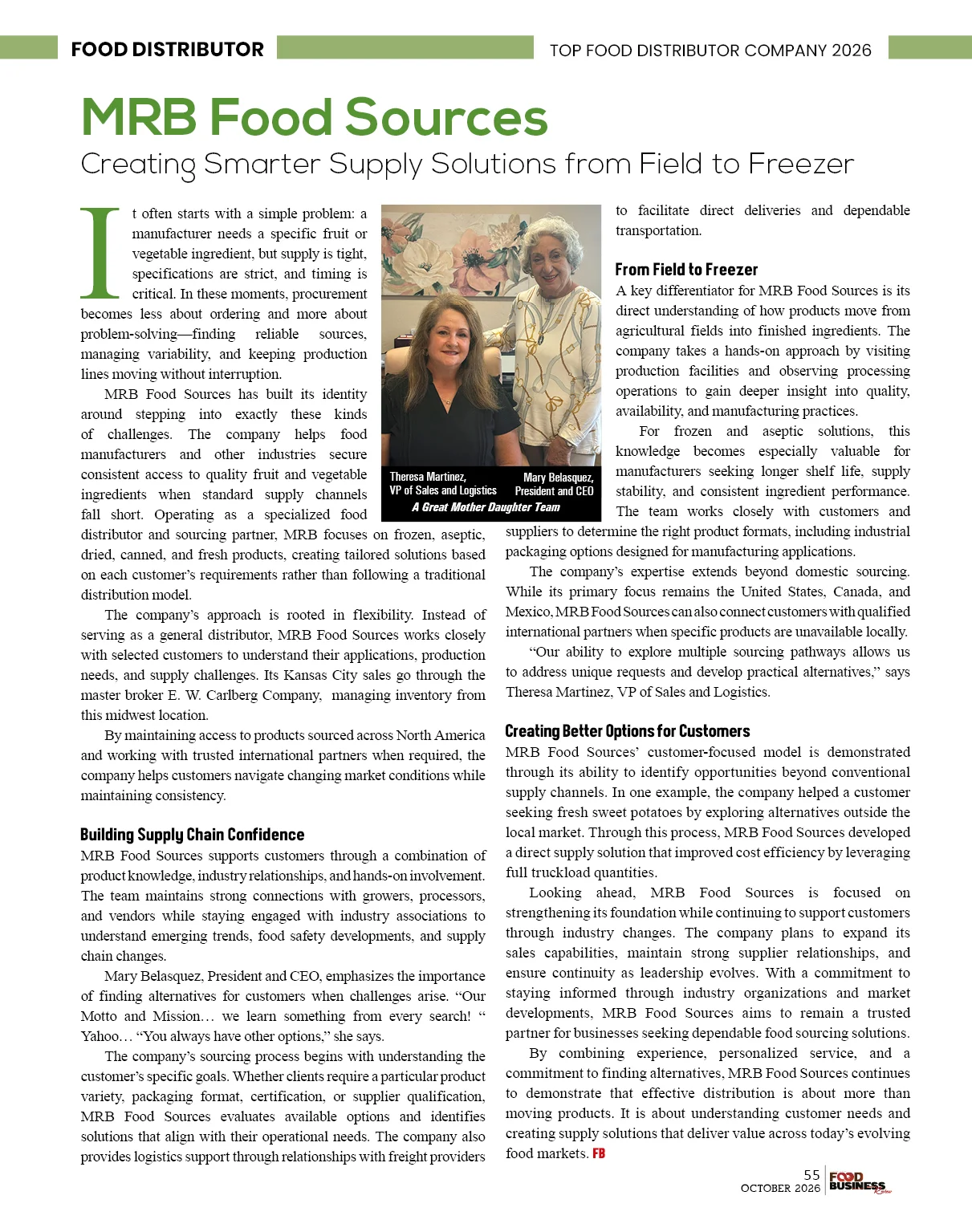
Management Mary Belasquez, President and CEO and Theresa Martinez, VP of Sales and Logistics
Description
MRB Food Sources helps manufacturers and industrial customers overcome food supply challenges through specialized sourcing, distribution, and logistics solutions. With expertise across frozen, aseptic, fresh, dried, and canned products, the company delivers flexible options, trusted relationships, and customer-focused strategies from field to freezer.