Thank you for Subscribing to Food Business Review Weekly Brief

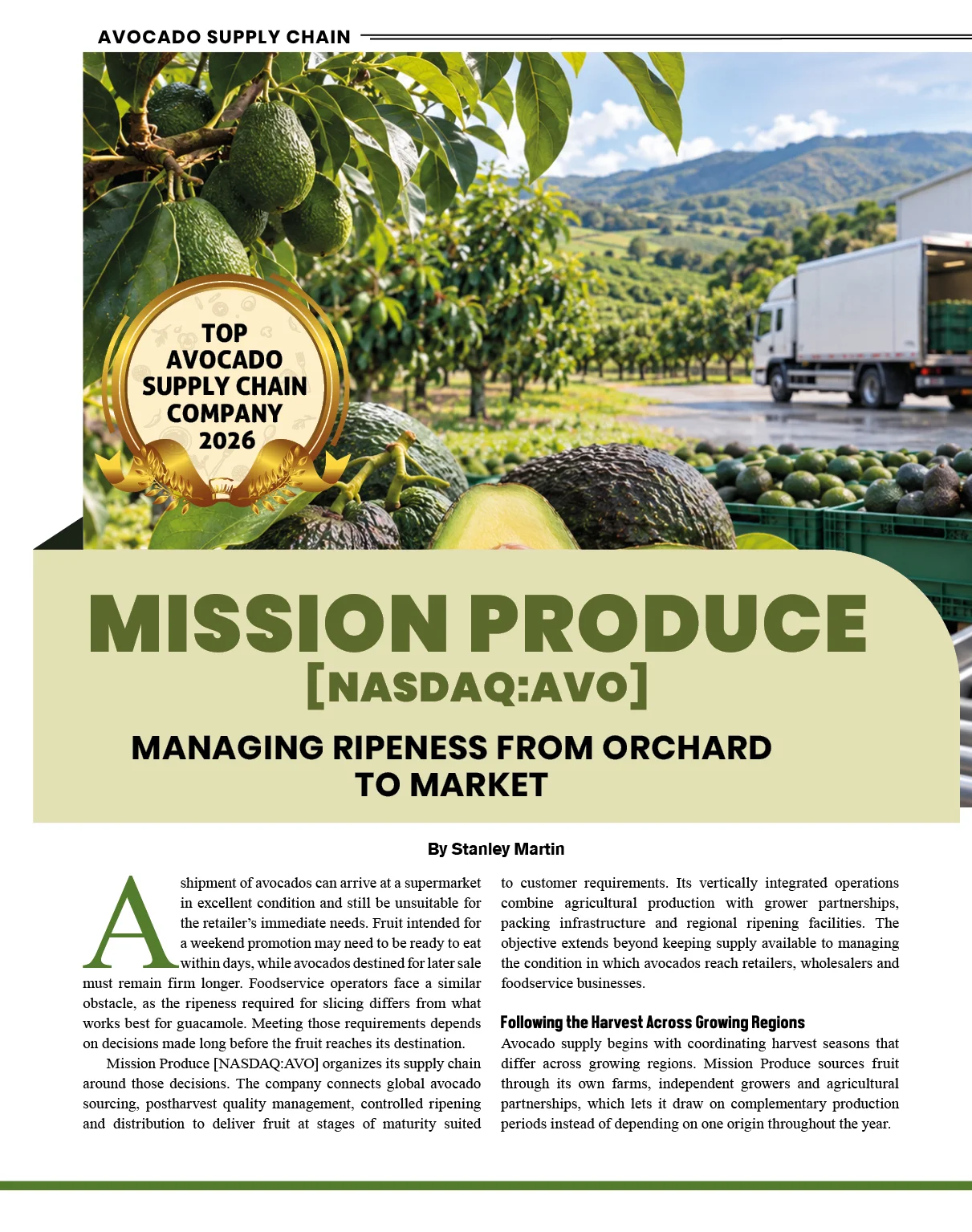
Mission Produce [NASDAQ:AVO] has been recognized by Food Business Review Magazine as the exclusive recipient of “Top Avocado Supply Chain Company 2026,” based on our proprietary methodology, reflecting its position in the industry, and is also named among “Top F&B Distributors,” reflecting its broader leadership. This profile has been developed by the Food Business Review research and editorial team based on insights from an interview with John Pawlowski, CEO.

Mission Produce [NASDAQ:AVO]
Managing Ripeness from Orchard to Market

A shipment of avocados can arrive at a supermarket in excellent condition and still be unsuitable for the retailer’s immediate needs. Fruit intended for a weekend promotion may need to be ready to eat within days, while avocados destined for later sale must remain firm longer. Foodservice operators face a similar obstacle, as the ripeness required for slicing differs from what works best for guacamole. Meeting those requirements depends on decisions made long before the fruit reaches its destination.
Mission Produce [NASDAQ:AVO] organizes its supply chain around those decisions. The company connects global avocado sourcing, postharvest quality management, controlled ripening and distribution to deliver fruit at stages of maturity suited to customer requirements. Its vertically integrated operations combine agricultural production with grower partnerships, packing infrastructure and regional ripening facilities. The objective extends beyond keeping supply available to managing the condition in which avocados reach retailers, wholesalers and foodservice businesses.
Following the Harvest Across Growing Regions
Avocado supply begins with coordinating harvest seasons that differ across growing regions. Mission Produce sources fruit through its own farms, independent growers and agricultural partnerships, which lets it draw on complementary production periods instead of depending on one origin throughout the year.
Peru is an important production base, particularly for summer supply to international markets. California remains part of the company’s sourcing network, supported by relationships with growers along the Pacific Coast. Guatemala offers another production window that complements Peru’s season, while partnerships in Colombia and a farming joint venture in South Africa extend its sourcing options for European and UK markets. These relationships involve more than purchasing harvested fruit. Mission Produce provides agronomy support, including cultivation guidance, training and orchard management expertise, and its direct farming operations also give it a role in production planning and harvest management. Together, these activities help the company match fruit availability to expected customer demand.
Seasonal sourcing also affects decisions made later in the supply chain. Avocados from different origins may mature differently, so knowing their growing conditions matters for subsequent handling and ripening.
Protecting Quality Before Ripening Begins
An avocado’s condition at harvest affects how it responds to transportation, storage and ripening. Mission Produce addresses this with quality controls that begin before the fruit enters the packing process.
Mission Produce connects global sourcing, quality management and precision ripening to deliver avocados at stages of maturity suited to each customer’s requirements.
Mission Produce continues its quality assurance at distribution facilities, where incoming shipments are inspected for appearance, temperature, grade and maturity. Before dispatch, teams check packaging, pallet conditions and other requirements tied to customer orders.
Food safety management runs alongside these controls. A centralized department sets programs across the company’s network, supported by local representatives and recognized certifications at applicable facilities. Together, these practices link quality at the farm to the conditions required for successful ripening and delivery.
Turning Ripeness into a Delivery Specification
Once fruit reaches a ripening facility, Mission Produce’s objective becomes more precise. Customers are not simply ordering avocados; they can specify how close to ready-to-eat the fruit should be when it is delivered. The company has been building commercial ripening capabilities since it opened its first ripe center in 1998. Its specialists, known as Ripe Masters, evaluate incoming fruit and manage temperature and ethylene conditions to guide the ripening process. Origin, size and maturity all influence the treatment selected, making the operation dependent on both scientific assessment and practical experience.
Mission Produce offers five stages of ripeness. Hard avocados typically need five or more days to ripen at room temperature, while pre-conditioned fruit generally needs four to five days. Breaking-stage avocados are closer to readiness, often requiring approximately two days. Firm-ripe fruit is suited to slicing and dicing, and fully ripe avocados are appropriate for mashing and spreading.
These distinctions have direct commercial uses. A retailer preparing a promotion can select fruit to match its planned selling period. One foodservice customer may require firm-ripe avocados for slicing, while another needs fully ripe fruit for guacamole. Ripeness becomes a specification, ordered alongside size, quantity and delivery date.
Mission Produce has also invested in technology designed to improve consistency within the ripening process. Its Mission Control system, deployed in the UK, allows avocados arriving in different initial conditions to be brought toward a common ripeness level within one room. The company reports improvements in quality consistency of up to 38 percent compared with standard ripening systems. The significance lies in managing variation across fruit sourced from different origins. Rather than assuming that every avocado will mature identically, Mission Produce adjusts the process so the fruit is ready when expected.
Connecting Ripening with Distribution
Precise ripening becomes commercially useful only when the fruit can reach customers within the intended window. Mission Produce connects its ripening operations with packinghouses and forward distribution facilities positioned near important markets.
Its network spans North America, Europe, the UK and Asia. Facilities in California and Texas support US distribution and cross-border supply, while operations in England and the Netherlands provide ripening and distribution capabilities for European markets. The company also maintains facilities in China to support regional demand. These locations help position inventory to match customer delivery schedules. Fruit can enter regional facilities for inspection, ripening, packing or distribution according to its intended use. Temperature management remains important during storage and transportation because changes in handling conditions can affect the ripening schedule established earlier.
-
By treating ripeness as a supply chain specification, Mission Produce aligns agricultural production, postharvest handling and distribution with the moment fruit is needed.
Mission Produce also offers bagging, custom packing and logistical management. These services match the fruit to the format customers need, whether in bulk shipments or packaged retail offerings. The distribution system therefore serves a function beyond moving avocados between locations. It provides the infrastructure through which sourcing decisions and controlled ripening are translated into customer-specific deliveries.
Connecting Supply with Retail Demand
The final stage of the avocado journey introduces another source of information: how customers purchase and use the fruit.
Mission Produce’s AvoIntel platform combines shopper insights, sales data and merchandising analysis to help retailers evaluate product assortments and promotional opportunities. The company can use these findings to recommend different avocado sizes, packaging formats or ripeness programs according to demand.
In one example documented by the company, analysis of a regional grocery retailer’s shoppers identified demand for larger avocados. Mission Produce recommended adding its Mission Jumbos bagged offering, and the retailer recorded a 33 percent increase in average weekly bag unit sales during the measured comparison periods. The result illustrates one customer application rather than a guaranteed outcome.
Mission Produce further expanded its North American operations through the acquisition of Calavo Growers in May 2026. The transaction added sourcing and distribution capabilities alongside a prepared foods portfolio that includes guacamole. Integration activities provide opportunities to coordinate complementary infrastructure, although the anticipated operational benefits remain dependent on execution.
For Mission Produce, what customers need at the point of sale connects directly to earlier supply chain decisions. Growing origins determine availability, postharvest handling protects quality, ripening establishes readiness and distribution places the fruit within reach of customers. A retailer receiving hard avocados for later sale and a foodservice operator needing fruit ready for immediate preparation may depend on the same global sourcing network. What distinguishes their orders is how Mission Produce coordinates the stages between harvest and delivery. Its approach treats ripeness as an operational requirement throughout the avocado supply chain, tying fruit availability to the moment customers need it ready to use.
Company :
Mission Produce [NASDAQ:AVO]
Headquarters :
. ManagementJohn Pawlowski, CEO
Description
Mission Produce is a global fresh produce company specializing in avocado sourcing, farming, packing, ripening and distribution. Its integrated supply chain combines international growing operations, quality management, customized ripening programs and regional logistics infrastructure to serve retail, wholesale and foodservice customers.