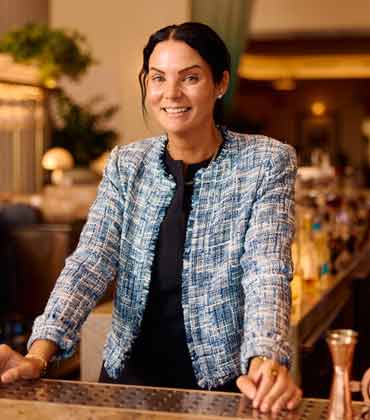
Jennifer Ottman
Jennifer Ottmann is a luxury hospitality leader with experience spanning The Boca Raton, Thomas Keller Restaurant Group, Baha Mar and Margaritaville Caribbean Group. She brings extensive expertise in food and beverage operations, financial management and guest experience, combining operational discipline with people-focused leadership to deliver exceptional hospitality at scale.
Systemizing Consistency Across a Large-Scale Operation
Consistency has to be systemized. At scale, you cannot personally oversee every interaction, so the standard has to live inside the organization rather than inside one leader.
That starts with defining service in terms people can actually act on. Telling a team to deliver luxury means very little. Associates need to know exactly what five-star service looks and sounds like at their specific touchpoint, using language that is clear and measurable.
When I arrived at The Boca Raton, we had the teams write the food and beverage standard operating procedure manual and the leadership accountability framework. This ensured a connection to the deliverables and created a stronger sense of ownership. That is still what we run on across more than 20 outlets and a team of more than 700.
From there, it becomes a leadership question. You have to develop leaders who can inspect what you expect because the leadership team is the multiplier of your standards. Once the fundamentals are being executed consistently, you empower associates to personalize from there. Luxury service is largely about anticipation, recognizing what a guest needs before they have to ask. That only happens when people are secure enough in the basics to look up and pay attention.
At our scale, communication between outlets and departments matters as much as what happens inside any individual restaurant. You cannot scale luxury by relying on exceptional individuals. You scale it by building a culture and the systems that allow exceptional service to happen consistently.
Translating Fine-Dining Discipline to Resort Scale
Michelin-level environments taught me that great service is extraordinarily intentional. Very little happens by accident. The biggest lesson was not formality but discipline: preparation, product knowledge, attention to detail, sequencing, communication and accountability.
Michelin-level environments taught me that great service is extraordinarily intentional.
At resort scale, you cannot simply replicate a fine-dining restaurant across every outlet, and you should not try. You translate the discipline, not the formality. The preparation behind a tasting menu is the same preparation that should sit behind a pool service shift. It just looks different when it gets to the guest.
Fine dining also teaches you to notice the smallest details because guests experience the sum of hundreds of small moments rather than one large one. The other thing I carried over is the value of simplicity. The more complicated the standard, the harder it is to execute consistently across hundreds of people. At scale, a simple standard executed every time will beat an elaborate one executed occasionally.
Balancing Creativity With Financial Discipline
Creativity and financial discipline are not opposing forces. The best concepts need both.
Every concept has to begin with an understanding of the guest or member, the market and the business opportunity rather than with the desire to create something exciting. One of the first questions I ask is whether a concept is incremental or cannibalistic. Is it creating new demand, or is it simply moving existing guests and existing revenue from another outlet? Those are very different outcomes.
We run a workshop modeled on Shark Tank, where venue leaders pitch new dining concepts and guest engagement ideas directly to the executive team.
I also look closely at the cost of complexity. A concept can generate strong revenue while creating disproportionate labor, inventory or operational costs, and that only surfaces if you are looking for it.
Beyond that, luxury operators have to understand where spending genuinely enhances the guest experience and where it does not. Sometimes the financially intelligent decision is to spend more because the investment materially changes the experience. Financial fluency is what allows you to defend those investments with data rather than saying, “This is simply what luxury requires.”
Balancing Luxury Standards With Operational Realities
The most common mistake is assuming luxury means more: more amenities, more menu items, more labor, more steps of service. In reality, luxury is often about doing fewer things exceptionally well.
The second is making financial decisions in isolation. Cutting labor or expenses may improve a line on the profit and loss statement while damaging the guest experience and, eventually, the revenue. The reverse is equally true. Luxury cannot become an excuse for uncontrolled spending or inefficient operations.
What resolves both is knowing which touchpoints matter most to the guest and protecting those relentlessly, then being disciplined everywhere else. Labor productivity is a good example. It should be about deploying people where they create the greatest impact, not simply reducing headcount.
Growing Into Broader Hospitality Leadership
Become financially fluent early. Learn to read a profit and loss statement and understand why the numbers moved, not just whether you made budget.
Seek assignments that make you uncomfortable or put you in areas where you are not yet an expert. That is usually where the growth is. Also, learn how to develop leaders rather than being the person who solves every operational problem. As your responsibility grows, your success depends more and more on what your leaders can accomplish when you are not in the room.
Stay operationally connected. Senior leadership should not mean losing touch with the floor, the associates or the guest.
Finally, be willing to take feedback and change your leadership style as your scope grows. What makes someone a great restaurant manager will not necessarily make them a great executive. Early in your career, you are rewarded for what you can personally execute. As a senior leader, you are measured by what you can build, who you can develop and what succeeds without you.