
Thank you for Subscribing to Food Business Review Weekly Brief


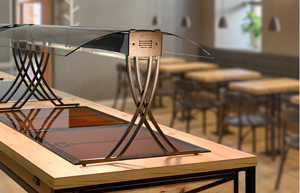
 Alexis Facchina, Commercial Director
Buffet equipment has to do more than hold and serve food. Its performance affects how efficiently a line operates, how well food is maintained and how customers perceive what is being served. For operators making a long-term equipment investment, those considerations shape both the operation and the experience it creates.
For Glasart, presentation is more than an aesthetic consideration. It treats design as a revenue tool for clients, engineering equipment that frames food effectively while supporting temperature control, hygiene and efficient service.
“We engineer for the people who use the equipment every day, not just for the people who admire it,” says Alexis Facchina, commercial director.
A Brazilian family company founded 38 years ago, Glasart began by producing mirrors, picture frames and other gift items. About two decades ago, it developed and patented thermoelectric glass, an innovation that transformed buffet configurations by integrating temperature management into the presentation surface. The product became the foundation for Glasart’s specialization in buffet equipment and the development of a comprehensive portfolio for the segment. Today, it has approximately 15,000 customers and is recognized as a market leader in buffet equipment across Latin America.
Designing around the Realities of Foodservice
Glasart starts each project with a consultative assessment rather than a standard catalog approach. It looks at the menu and what needs to stay fresh and safe, the physical space and how people move through it, expected traffic and peak demand and the service style. It then recommends a configuration from its modular line, adapting dimensions where necessary and providing layout guidance and technical drawings.
-
We engineer for the people who use the equipment every day, not just for the people who admire it.
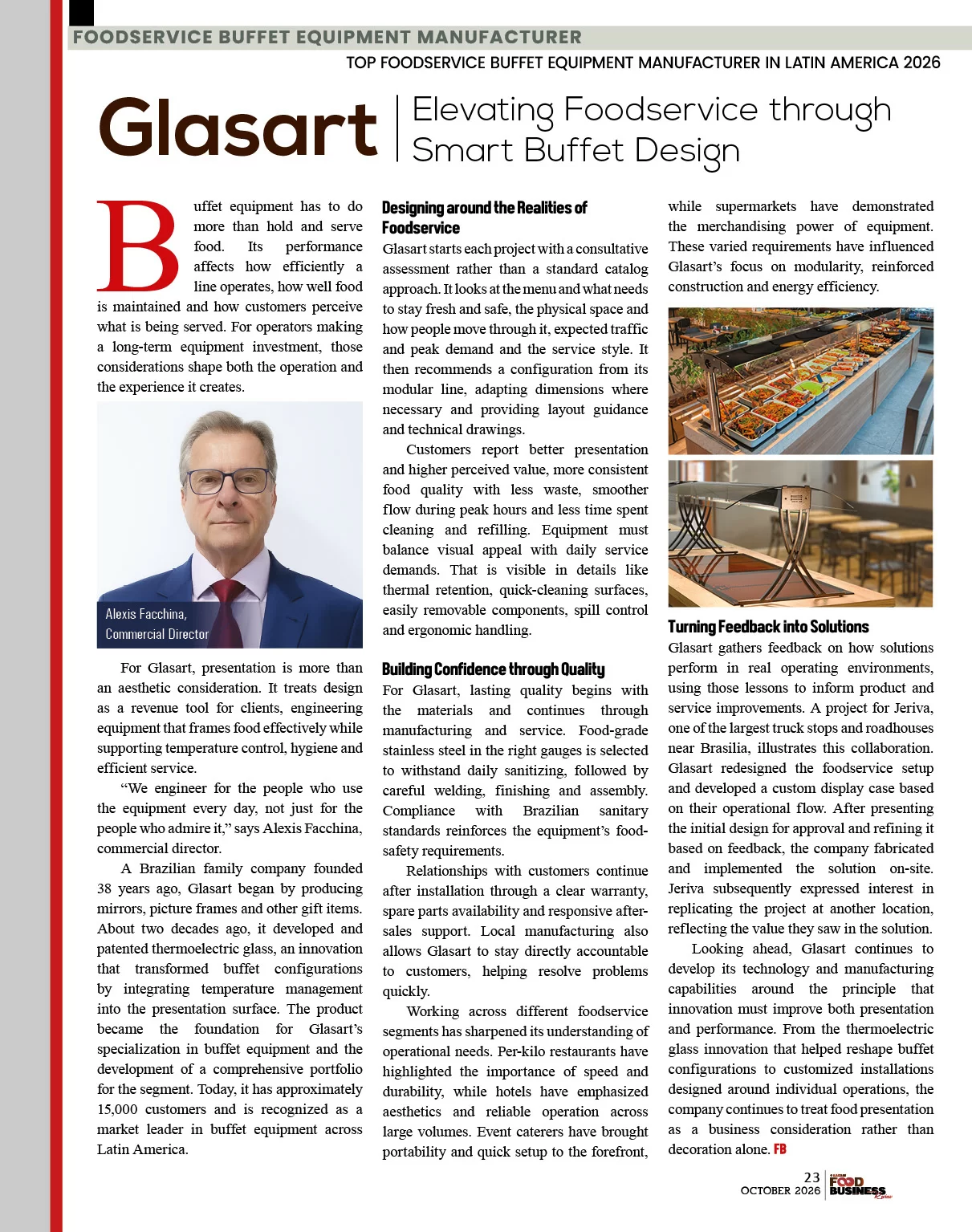
Customers report better presentation and higher perceived value, more consistent food quality with less waste, smoother flow during peak hours and less time spent cleaning and refilling. Equipment must balance visual appeal with daily service demands. That is visible in details like thermal retention, quick-cleaning surfaces, easily removable components, spill control and ergonomic handling.
Building Confidence through Quality
For Glasart, lasting quality begins with the materials and continues through manufacturing and service. Food-grade stainless steel in the right gauges is selected to withstand daily sanitizing, followed by careful welding, finishing and assembly. Compliance with Brazilian sanitary standards reinforces the equipment's food-safety requirements.
 Relationships with customers continue after installation through a clear warranty, spare parts availability and responsive after-sales support. Local manufacturing also allows Glasart to stay directly accountable to customers, helping resolve problems quickly.
Working across different foodservice segments has sharpened its understanding of operational needs. Per-kilo restaurants have highlighted the importance of speed and durability, while hotels have emphasized aesthetics and reliable operation across large volumes. Event caterers have brought portability and quick setup to the forefront, while supermarkets have demonstrated the merchandising power of equipment. These varied requirements have influenced Glasart's focus on modularity, reinforced construction and energy efficiency.
Turning Feedback into Solutions
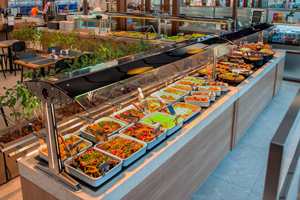
 Glasart gathers feedback on how solutions perform in real operating environments, using those lessons to inform product and service improvements. A project for Jeriva, one of the largest truck stops and roadhouses near Brasilia, illustrates this collaboration. Glasart redesigned the foodservice setup and developed a custom display case based on their operational flow. After presenting the initial design for approval and refining it based on feedback, the company fabricated and implemented the solution on-site. Jeriva subsequently expressed interest in replicating the project at another location, reflecting the value they saw in the solution.
Looking ahead, Glasart continues to develop its technology and manufacturing capabilities around the principle that innovation must improve both presentation and performance. From the thermoelectric glass innovation that helped reshape buffet configurations to customized installations designed around individual operations, the company continues to treat food presentation as a business consideration rather than decoration alone.
Buffet Equipment Built for Service and Merchandising
Buffet equipment is easy to judge by appearance, and expensive to judge only after installation. A line that photographs well can still become a poor long-term purchase if temperature drifts during service or if cleaning takes too long. Trouble can surface later when replacement parts are difficult to obtain or when support is slow. For restaurants and hotels, the buying decision sits at the intersection of food presentation and daily service pressure. Equipment must support the food on display without creating extra work for the people maintaining it.
Temperature control deserves close attention because it affects both food quality and service consistency. A buffet line may face changing traffic over several hours, making stable heat retention more useful than short bursts of performance. Buyers should look closely at how the equipment maintains serving conditions and whether food-contact areas can be reached easily for cleaning. Material selection also matters over the years of use. Food-grade stainless steel in suitable gauges and careful fabrication provides a better basis for repeated sanitizing, while compliance with applicable sanitary requirements adds another check on suitability.
Cleaning and handling expose another part of the purchase that is often underestimated. Components that detach without difficulty can shorten turnaround between service periods. Spill control and ergonomic handling can also reduce the attention the line demands during busy hours. Peak-period performance is therefore not only about holding more food. It depends on whether staff can refill, clean, adjust and reset the setup without slowing guest movement. Buyers should examine the practical details that affect those tasks rather than relying on catalog specifications alone.
“The Glasart treats presentation as part of food merchandising rather than a decorative afterthought, which makes its offering particularly relevant to foodservice operators balancing service performance with display quality.”
Presentation carries a commercial role of its own. In self-service and other display-led formats, the equipment frames the food that customers are asked to choose. Poor sightlines or an awkward layout can weaken merchandising even when the underlying equipment performs correctly. Configuration should therefore reflect the menu and physical space as well as traffic patterns and style of service. Modular systems can be useful where layouts change over time, while dimensional customization can prevent a standard product from forcing compromises in circulation or display. A manufacturer that can provide layout guidance and technical drawings before production gives buyers a better chance of resolving those issues before fabrication.
Long-term support should be examined with the same care as the equipment itself. A clear warranty means little if parts become difficult to source later. Local manufacturing can reduce that risk when it is paired with spare-parts availability and responsive after-sales service. The more specialized the buffet line becomes, the more important direct accountability is when a component requires adjustment or replacement.
Glasart is a premier choice for buyers who want buffet equipment shaped around these practical requirements. It combines thermoelectric glass for temperature maintenance with a modular buffet line that can be adapted in dimension and configuration. Its manufacturing approach uses food-grade stainless steel and supports customized layouts. Technical drawings are provided before production, while warranty coverage and after-sales support extend beyond installation. Spare parts remain available over the equipment's life. The Glasart treats presentation as part of food merchandising rather than a decorative afterthought, which makes its offering particularly relevant to foodservice operators balancing service performance with display quality.
...Read more
Insights
A New Generation of Foodservice Leadership
Andressa Sophie Facchina Ribeiro, Export and Marketing Manager If a solution improves the customer experience, increases operational efficiency and remains relevant years from now, it is a worthwhile investment.

Foodservice Buffet Equipment Manufacturers in Latin America Info
Q1
What Do Foodservice Buffet Equipment Manufacturers Provide for Professional Food Service?
Foodservice Buffet Equipment Manufacturers develop the equipment used to organize, display, protect, heat and refrigerate food during service. Their product range can include heated and refrigerated serving surfaces, display equipment, sneeze guards, heating lamps, serving vessels, counters and furniture. The goal is not simply to hold food but to support an orderly service environment where temperature control, accessibility, presentation and operational flow all work together.
Q2
How Does Glasart Approach Buffet Equipment for Different Foodservice Operations?
Glasart approaches Foodservice Buffet Equipment Manufacturers as a broad equipment discipline rather than a single-product business. Founded in 1987, it entered the foodservice market in 2006 with the development of its thermoelectric glass technology, which later supported a wider buffet equipment line. Today, its portfolio includes solutions for hot and cold food distribution, display, protection and service, alongside customized projects shaped around operational requirements.
Q3
Why Are Temperature Control and Food Presentation Important in Buffet Service?
For Foodservice Buffet Equipment Manufacturers, temperature management and presentation are closely connected. Equipment must help maintain appropriate conditions for hot or chilled food while allowing dishes to remain visible and accessible during service. The design of serving surfaces, refrigerated lanes and heating systems can also influence how efficiently food is replenished. Good buffet equipment therefore has to address practical performance without treating presentation as an afterthought.
Q4
What Should Businesses Consider When Choosing Food Distribution Equipment?
Organizations evaluating Foodservice Buffet Equipment Manufacturers should look beyond individual product specifications and consider how equipment will function within the full service setup. Important factors include available space, service capacity, food types, workflow and the need for hot or cold holding. Durability and maintenance requirements also matter in environments subject to frequent use. Equipment should support the way food moves from preparation through display and service rather than creating additional operational complications.
Q5
How Can Customized Buffet Projects Improve Service Flow?
Customized projects allow Foodservice Buffet Equipment Manufacturers to adapt equipment arrangements to the realities of a particular operation. Layout, service flow and capacity can affect where counters, food displays, heating equipment and refrigerated units are placed. A more deliberate configuration can make the service area easier to operate while creating a coherent visual environment. Customization becomes particularly useful when standard equipment dimensions do not match the physical or operational needs of the location.
Q6
What Makes Glasart Relevant Among Foodservice Buffet Equipment Manufacturers?
Glasart illustrates how Foodservice Buffet Equipment Manufacturers can combine specialized technology with a wider approach to food distribution. Its equipment is used across restaurants, hotels, bakeries, supermarkets and industrial kitchens, while its projects can be adapted to different layouts and service requirements. The company also develops equipment spanning hot and refrigerated food service, food protection, presentation and supporting furniture. Its thermoelectric glass technology remains part of the foundation of its foodservice offering, reflecting the company's move from a focused innovation into a broader buffet equipment portfolio.
Company :
Glasart
Management Alexis Facchina, Commercial Director
Description
Glasart is a Brazilian manufacturer specializing in buffet equipment for restaurants, hotels, supermarkets and event caterers. Its portfolio combines design, quality and practicality, with customizable solutions, thermoelectric technology and local manufacturing capabilities that support food presentation, operational efficiency, hygiene and reliable performance.