
Thank you for Subscribing to Food Business Review Weekly Brief


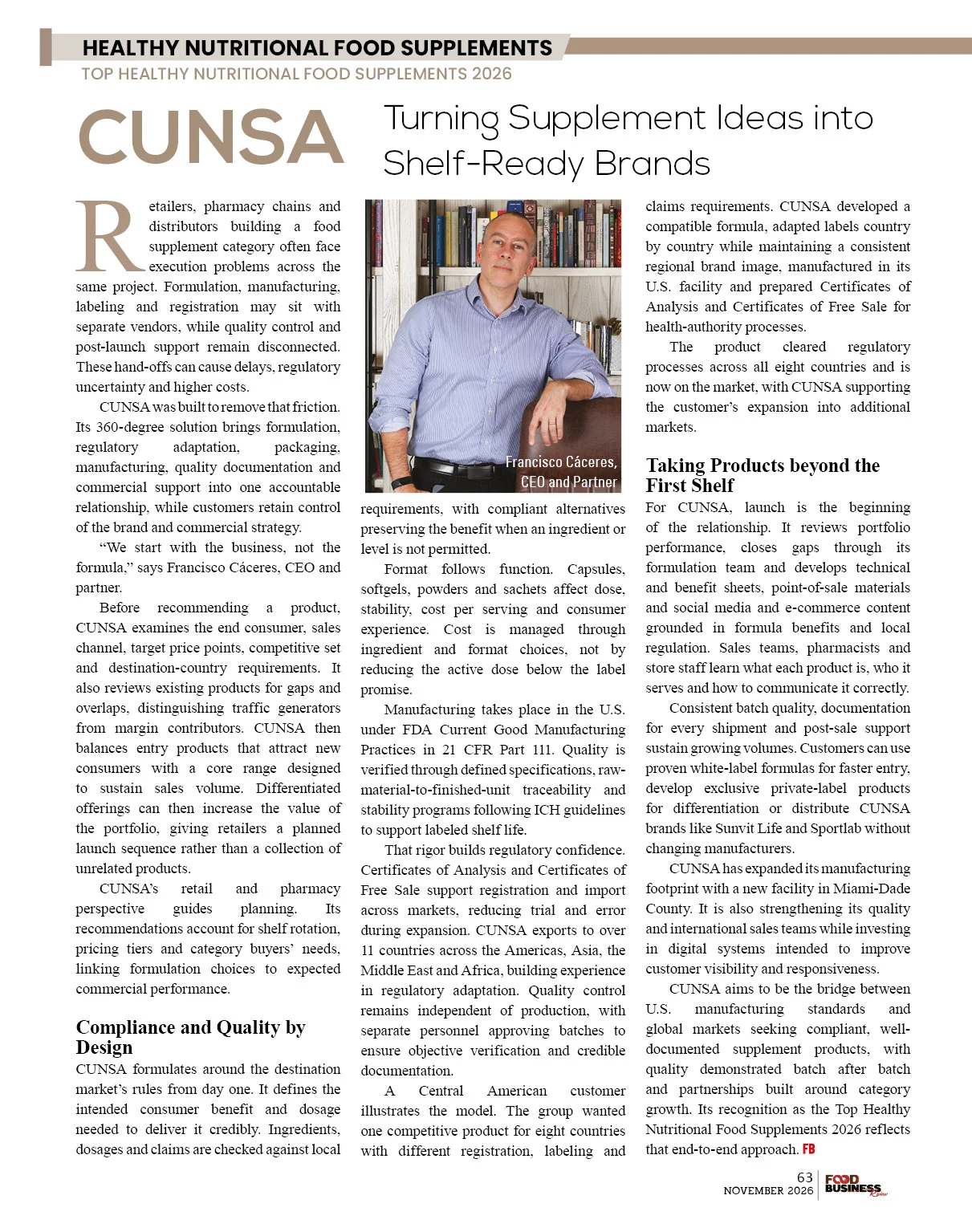
 Francisco Cáceres, CEO and Partner
Retailers, pharmacy chains and distributors building a food supplement category often face execution problems across the same project. Formulation, manufacturing, labeling and registration may sit with separate vendors, while quality control and post-launch support remain disconnected. These hand-offs can cause delays, regulatory uncertainty and higher costs.
CUNSA was built to remove that friction. Its 360-degree solution brings formulation, regulatory adaptation, packaging, manufacturing, quality documentation and commercial support into one accountable relationship, while customers retain control of the brand and commercial strategy.
“We start with the business, not the formula,” says Francisco Cáceres, CEO and partner.
Before recommending a product, CUNSA examines the end consumer, sales channel, target price points, competitive set and destination-country requirements. It also reviews existing products for gaps and overlaps, distinguishing traffic generators from margin contributors. CUNSA then balances entry products that attract new consumers with a core range designed to sustain sales volume. Differentiated offerings can then increase the value of the portfolio, giving retailers a planned launch sequence rather than a collection of unrelated products.
CUNSA’s retail and pharmacy perspective guides planning. Its recommendations account for shelf rotation, pricing tiers and category buyers’ needs, linking formulation choices to expected commercial performance.
Compliance and Quality by Design
CUNSA formulates around the destination market’s rules from day one. It defines the intended consumer benefit and dosage needed to deliver it credibly. Ingredients, dosages and claims are checked against local requirements, with compliant alternatives preserving the benefit when an ingredient or level is not permitted.
Format follows function. Capsules, softgels, powders and sachets affect dose, stability, cost per serving and consumer experience. Cost is managed through ingredient and format choices, not by reducing the active dose below the label promise.
-
We start with the business, not the formula.
Manufacturing takes place in the U.S. under FDA Current Good Manufacturing Practices in 21 CFR Part 111. Quality is verified through defined specifications, raw-material-to-finished-unit traceability and stability programs following ICH guidelines to support labeled shelf life.
That rigor builds regulatory confidence. Certificates of Analysis and Certificates of Free Sale support registration and import across markets, reducing trial and error during expansion. CUNSA exports to over 11 countries across the Americas, Asia, the Middle East and Africa, building experience in regulatory adaptation. Quality control remains independent of production, with separate personnel approving batches to ensure objective verification and credible documentation.
A Central American customer illustrates the model. The group wanted one competitive product for eight countries with different registration, labeling and claims requirements. CUNSA developed a compatible formula, adapted labels country by country while maintaining a consistent regional brand image, manufactured in its U.S. facility and prepared Certificates of Analysis and Certificates of Free Sale for health-authority processes.
The product cleared regulatory processes across all eight countries and is now on the market, with CUNSA supporting the customer’s expansion into additional markets.
Taking Products beyond the First Shelf
For CUNSA, launch is the beginning of the relationship. It reviews portfolio performance, closes gaps through its formulation team and develops technical and benefit sheets, point-of-sale materials and social media and e-commerce content grounded in formula benefits and local regulation. Sales teams, pharmacists and store staff learn what each product is, who it serves and how to communicate it correctly.
Consistent batch quality, documentation for every shipment and post-sale support sustain growing volumes. Customers can use proven white-label formulas for faster entry, develop exclusive private-label products for differentiation or distribute CUNSA brands like Sunvit Life and Sportlab without changing manufacturers.
CUNSA has expanded its manufacturing footprint with a new facility in Miami-Dade County. It is also strengthening its quality and international sales teams while investing in digital systems intended to improve customer visibility and responsiveness.
CUNSA aims to be the bridge between U.S. manufacturing standards and global markets seeking compliant, well-documented supplement products, with quality demonstrated batch after batch and partnerships built around category growth. Its recognition as the Top Healthy Nutritional Food Supplements 2026 reflects that end-to-end approach.
Regulatory Readiness in Supplement Supplier Selection
A supplement line can reach the manufacturing stage before anyone establishes whether its dosage or label claims will clear registration in the destination market. For pharmacy chains and distributors carrying private-label products across borders, that sequencing can leave finished inventory awaiting changes to a formula that should have been settled months earlier. Supplier comparisons must reach beyond unit pricing to establish where responsibility for regulatory feasibility begins.
Formulation decisions are inseparable from the country of sale. An ingredient permitted in one jurisdiction may face a different dosage limit elsewhere, while wording that works on a domestic label may prevent import approval. Before committing to a production run, purchasers should establish whether a manufacturer can review proposed ingredients against local rules and coordinate compliant labels. The sequence matters. Revising artwork is relatively contained; changing an active ingredient after production planning can affect the promised benefit and the economics of the entire line.
The consumer proposition also has to survive manufacturing constraints. A capsule may accommodate a target dose economically, whereas a powder or sachet may offer a better serving size at a different retail price. Packaging decisions influence shelf space and the quantity a customer must purchase per transaction. Formulations should preserve the intended benefit at a usable dose. Stability data must support the stated shelf life. Reducing an active ingredient merely to reach a price point risks weakening the proposition the label is supposed to communicate.
“CUNSA also coordinates label adaptation and supplies documentation for registration and export, reducing handoffs between technical work and market entry.”
Batch documentation separates an auditable manufacturing arrangement from one that depends on supplier assurances. Buyers need to know how raw materials are identified and who authorizes finished lots for release. Certificates of Analysis should correspond to individual batches rather than generic product descriptions. Independent quality-release authority and traceability become particularly consequential when shipment documentation is reviewed by a distributor or health authority abroad. A manufacturer's production capacity says little about how readily it can investigate a disputed lot.
A broad assortment is no substitute for a deliberate product range. Pharmacy and retail buyers must weigh traffic-generating items against products that can sustain margins without multiplying slow-moving stock. Price tiers should reflect the channel's purchasing behavior, while launch volumes need to accommodate uncertain demand. A supplier offering ready-developed formulations may shorten the launch cycle, but exclusive development can offer greater control over product positioning. Commercial support after delivery can also affect whether store staff understand permitted product claims. The contract should clarify who updates technical information when formulas or market requirements change.
CUNSA develops supplement portfolios around the destination market's rules and intended retail channel, combining formulation and private-label manufacturing with regulatory documentation. Its U.S. production follows FDA dietary supplement current good manufacturing practices under 21 CFR Part 111, supported by lot-specific Certificates of Analysis and raw-material traceability. CUNSA also coordinates label adaptation and supplies documentation for registration and export, reducing handoffs between technical work and market entry. Customers can use established white-label formulations or commission exclusive products, while retaining control of their own brands. Its post-launch work includes portfolio reviews and training for pharmacy and retail staff. That model serves distributors and retail chains managing supplement ranges across markets with differing registration requirements.
...Read more
Healthy Nutritional Food Supplements Info
Q1
What Do Healthy Nutritional Food Supplements Include?
Healthy Nutritional Food Supplements cover products formulated to provide specific nutritional benefits through ingredients, dosages and delivery formats suited to consumer needs. They include capsules, softgels, powders and sachets, with each format offering different considerations for dosage, stability, cost per serving and convenience. Developing these products requires more than selecting ingredients. Healthy Nutritional Food Supplements must also account for intended benefits, appropriate formulations, labeling requirements and the regulations governing their destination markets.
Q2
How Does CUNSA Help Develop Nutritional Supplement Products?
CUNSA approaches Healthy Nutritional Food Supplements through an integrated development and manufacturing model. Its 360-degree service combines formulation, regulatory adaptation, packaging, manufacturing, quality documentation and commercial support. Before recommending a product, it evaluates the intended consumer, sales channel, target pricing, competitive landscape and destination-country requirements. It also helps structure product portfolios by distinguishing entry-level products from core offerings and differentiated additions. This approach connects product development with commercial planning while allowing customers to retain control of their brands and sales strategies.
Q3
What Regulatory Factors Matter When Developing Food Supplements?
Regulatory compliance influences ingredient selection, dosage levels, product claims and labeling. Healthy Nutritional Food Supplements intended for international distribution must satisfy the requirements of their destination markets, which can differ considerably. Formulation teams need to identify permitted ingredients and appropriate benefit claims before manufacturing begins. When a particular ingredient or dosage is restricted, alternative formulations may preserve the intended nutritional purpose. Clear documentation, compliant labels and market-specific registration processes also help reduce delays when products move between countries.
Q4
Why Are Manufacturing Standards Important for Supplement Quality?
Manufacturing consistency affects product safety, stability and consumer confidence. Healthy Nutritional Food Supplements require defined ingredient specifications, controlled production processes and verification that finished products match their labels. Traceability from raw materials to finished units helps establish accountability across production batches. Stability testing provides evidence supporting the stated shelf life, while independent quality checks help prevent production targets from influencing batch approval. These measures also give organizations the documentation needed to manage product registrations, imports and ongoing distribution.
Q5
How Does CUNSA Support International Supplement Market Entry?
CUNSA manufactures in the United States under FDA Current Good Manufacturing Practices in 21 CFR Part 111. Its quality processes include raw-material-to-finished-unit traceability, ICH-guided stability programs and independent batch approval. The company exports to more than 11 countries across the Americas, Asia, the Middle East and Africa. Its work includes adapting formulations and labels to different national requirements, supported by Certificates of Analysis and Certificates of Free Sale. In one regional project, it developed a product approved across eight Central American markets.
Q6
What Happens After a Nutritional Supplement Reaches the Market?
Commercial support remains important after launch because product performance, consumer understanding and portfolio requirements can change. Healthy Nutritional Food Supplements benefit from continued formulation reviews, consistent batch documentation and accurate product communication. Supporting materials such as technical sheets, point-of-sale information and digital content help explain product benefits within applicable regulatory limits. Training for sales teams, pharmacists and store staff can also improve how products are presented. Ongoing support helps organizations address portfolio gaps and maintain consistency as distribution expands.
Company :
CUNSA
Management Francisco Cáceres, CEO and Partner
Description
CUNSA helps retailers, pharmacies and distributors develop nutritional supplement portfolios through integrated formulation, regulatory guidance and U.S. manufacturing. Its 360-degree solution supports product quality, market entry and continued category growth through commercial guidance, marketing and sales-team training.