
Thank you for Subscribing to Food Business Review Weekly Brief


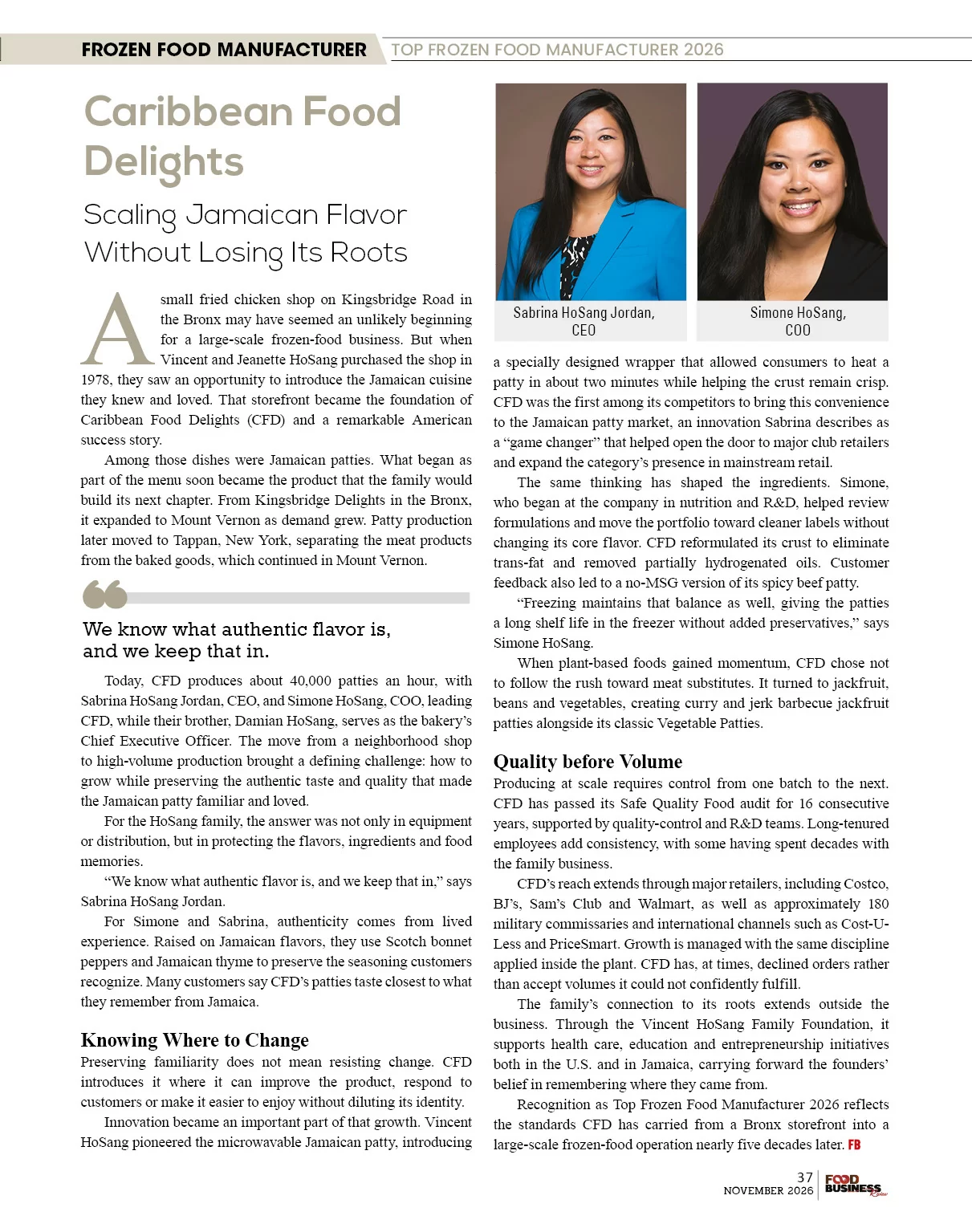
 Sabrina HoSang Jordan, CEO and Simone HoSang, COO
A small fried chicken shop on Kingsbridge Road in the Bronx may have seemed an unlikely beginning for a large-scale frozen-food business. But when Vincent and Jeanette HoSang purchased the shop in 1978, they saw an opportunity to introduce the Jamaican cuisine they knew and loved. That storefront became the foundation of Caribbean Food Delights (CFD) and a remarkable American success story.
Among those dishes were Jamaican patties. What began as part of the menu soon became the product that the family would build its next chapter. From Kingsbridge Delights in the Bronx, it expanded to Mount Vernon as demand grew. Patty production later moved to Tappan, New York, separating the meat products from the baked goods, which continued in Mount Vernon.
Today, CFD produces about 40,000 patties an hour, with Sabrina HoSang Jordan, CEO, and Simone HoSang, COO, leading CFD, while their brother, Damian HoSang, serves as the bakery’s Chief Executive Officer. The move from a neighborhood shop to high-volume production brought a defining challenge: how to grow while preserving the authentic taste and quality that made the Jamaican patty familiar and loved.
For the HoSang family, the answer was not only in equipment or distribution, but in protecting the flavors, ingredients and food memories.
“We know what authentic flavor is, and we keep that in,” says Sabrina HoSang Jordan.
For Simone and Sabrina, authenticity comes from lived experience. Raised on Jamaican flavors, they use Scotch bonnet peppers and Jamaican thyme to preserve the seasoning customers recognize. Many customers say CFD’s patties taste closest to what they remember from Jamaica.
Knowing Where to Change
Preserving familiarity does not mean resisting change. CFD introduces it where it can improve the product, respond to customers or make it easier to enjoy without diluting its identity.
Innovation became an important part of that growth. Vincent HoSang pioneered the microwavable Jamaican patty, introducing a specially designed wrapper that allowed consumers to heat a patty in about two minutes while helping the crust remain crisp. CFD was the first among its competitors to bring this convenience to the Jamaican patty market, an innovation Sabrina describes as a “game changer” that helped open the door to major club retailers and expand the category’s presence in mainstream retail.
-
We know what authentic flavor is, and we keep that in.
The same thinking has shaped the ingredients. Simone, who began at the company in nutrition and R&D, helped review formulations and move the portfolio toward cleaner labels without changing its core flavor. CFD reformulated its crust to eliminate trans-fat and removed partially hydrogenated oils. Customer feedback also led to a no-MSG version of its spicy beef patty.
“Freezing maintains that balance as well, giving the patties a long shelf life in the freezer without added preservatives,” says Simone HoSang.
When plant-based foods gained momentum, CFD chose not to follow the rush toward meat substitutes. It turned to jackfruit, beans and vegetables, creating curry and jerk barbecue jackfruit patties alongside its classic Vegetable Patties.
Quality before Volume
Producing at scale requires control from one batch to the next. CFD has passed its Safe Quality Food audit for 16 consecutive years, supported by quality-control and R&D teams. Long-tenured employees add consistency, with some having spent decades with the family business.
CFD’s reach extends through major retailers, including Costco, BJ’s, Sam’s Club and Walmart, as well as approximately 180 military commissaries and international channels such as Cost-U-Less and PriceSmart. Growth is managed with the same discipline applied inside the plant. CFD has, at times, declined orders rather than accept volumes it could not confidently fulfill.
The family’s connection to its roots extends outside the business. Through the Vincent HoSang Family Foundation, it supports health care, education and entrepreneurship initiatives both in the U.S. and in Jamaica, carrying forward the founders’ belief in remembering where they came from.
Recognition as Top Frozen Food Manufacturer 2026 reflects the standards CFD has carried from a Bronx storefront into a large-scale frozen-food operation nearly five decades later.
Authentic Frozen Food Built for Retail Consistency
Frozen food buyers face a harder test than finding a product that tastes distinctive. A regional recipe that succeeds in small batches can lose its identity once ingredient sourcing, production volume, retail formats and replenishment schedules begin shaping the product. Flavor has to remain recognizable from one pack to the next, while the manufacturer can reproduce it in quantities large enough for major accounts. For executives evaluating a frozen food producer, consistency should therefore be judged as a manufacturing discipline rather than a branding claim. Ingredient choices and recipe control need to support the same eating experience, while line capacity and packaging specifications must do so without forcing constant reformulation.
Food safety adds another layer of scrutiny because retail acceptance depends on more than passing required inspections. A manufacturer serving large chains has to show that quality controls are built into routine production and can withstand recurring external review. The useful question is not whether a plant has procedures on paper, but whether those procedures continue to hold as volume changes and new products move through the line. Certification history can provide one indicator, especially when the standard requires repeated audits. Cleaner labels can require ingredient changes that affect recipe character, so buyers should look for evidence that reformulation is handled without weakening the product consumers already recognize.
Product development creates a different risk. Frozen food manufacturers can chase every diet trend and end up with a scattered portfolio that strains sourcing and production. New ideas should have a clear demand signal, fit existing manufacturing realities, pass testing and justify the sourcing burden. Retailer requests can be useful inputs, but production feasibility still matters. Focus groups and store sampling can expose weak concepts before controlled production runs determine whether a launch is realistic. Packaging deserves similar attention because convenience can change how often a frozen item is used. A format that heats quickly, travels well, stores easily and still protects texture can broaden the occasions in which the product makes sense.
Channel fit ultimately ties these decisions together. Club stores and supermarkets often require different pack sizes from foodservice accounts, and each channel brings its own handling patterns. A manufacturer needs enough range to serve those formats without turning its core line into a collection of one-off products. Capacity should be assessed alongside order discipline. Accepting more business than the plant can fulfill creates a different problem than insufficient demand. A supplier that knows where its limits are and protects product quality through distribution is better placed to keep core recipes stable across long-term retail programs.
Caribbean Food Delights is a premier choice for buyers who want Jamaican-style frozen patties backed by established production discipline. It manufactures meat and plant-based offerings for retail and foodservice formats, including no-MSG and microwavable options. Its Tappan facility produces about 40,000 patties an hour. Caribbean Food Delights maintains a dedicated quality control structure and has completed SQF audits for 16 consecutive years. Its product development process combines buyer input with focus groups, then moves viable concepts into production testing before broader release. For executives balancing authentic flavor with repeatable supply, that combination gives the recommendation a practical basis rather than a promotional one.
...Read more
Frozen Food Manufacturers Info
Q1
What Defines Strong Frozen Food Manufacturers?
Frozen food producers have to get taste, texture and consistency correct, from ingredient sourcing right through to the final product in the freezer. Freezing will extend shelf life, but it won't fix a recipe that's not under good control or a manufacturing process that's not consistent. The buyer has to ask themselves whether the manufacturer can deliver the same product at scale, can maintain food safety and can adapt the packaging to the way the product is going to be stored, prepared and sold. That's what ultimately determines consistency.
Q2
What Does Caribbean Food Delights Bring to the Frozen Food Category?
Caribbean Food Delights combines Jamaican food traditions with high-volume production. Its Tappan, NY facility produces some 40,000 patties an hour. Scotch bonnet peppers and Jamaican thyme help retain the seasoning associated with its recipes. The company also developed a microwavable patty wrapper which enables the consumer to heat the product in about two minutes whilst still achieving a crisp crust. That's the sort of thing a frozen food manufacturer can do to provide convenience without sacrificing the product's essence.
Q3
Which Products and Formats Fall Within This Manufacturing Category?
The category is prepared and partially prepared foods which are stored and distributed frozen (from meat products through to veg and plant-based). The manufacturer may supply the supermarket shelf, the club or foodservice. Each of those channels will have different pack sizes, different preparation instructions and different handling requirements. The range that a producer has will be a function of both what the customer wants and what the producer can source and what they can produce consistently at scale. The breadth of the range is less important than the ability to deliver the products in the range at scale.
Q4
How Should Buyers Assess Quality and Product Consistency?
Buyers should examine ingredient checks, formulation controls and routine production testing rather than just quality in general. Repeat audits, a dedicated quality control team, and documented product testing are all far more useful. Frozen food manufacturers in particular need to be very careful when it comes to recipe changes. Removing an ingredient or changing a label can have a huge impact on flavor, texture and customer acceptance. Buyers should be asking how such proposed changes are assessed and whether the production controls will be able to maintain the agreed specification from batch to batch.
Q5
How Can Frozen Food Manufacturers Respond to Changing Food Preferences?
New product development can be a route to meeting changing ingredient preferences but the ideas have to be realistic in the context of sourcing and production. A move towards plant-based eating doesn't necessarily mean that every producer has to go in and do a meat substitute. They can look at vegetables, legumes and other ingredients to see if they can produce a product that meets customer expectations and can be made consistently. Reformulation has to be done with care as well. If you're attempting to simplify an ingredient list, then you mustn't in any way compromise the taste and texture that the customer has come to expect. For frozen food manufacturers in particular, there has to be a very clear reason for any product change.
Q6
How Does Caribbean Food Delights Manage Quality and Retail Supply at Scale?
Caribbean Food Delights has passed its Safe Quality Food audit for 16 consecutive years, supported by a quality control and R&D team. It supplies a number of major retailers (Costco, BJ's, Sam's Club, Walmart) as well as around 180 military commissaries and a number of international sites. The range is predominantly meat and plant-based patties for both retail and foodservice. The company has also turned down orders where it wasn't able to be confident it could meet the volume required. For a frozen food manufacturer, this is a clear illustration of the need for production capacity to be matched by consistent quality controls and realistic order commitments.
Company :
Caribbean Food Delights
Management Sabrina HoSang Jordan, CEO and Simone HoSang, COO
Description
Caribbean Food Delights manufactures authentic Jamaican frozen patties rooted in family tradition and flavor. Its portfolio includes beef, chicken, vegetable and plant-based varieties, serving both retail and foodservice markets. The company is known for rigorous quality standards, broad distribution and a longstanding commitment to community service and giving.